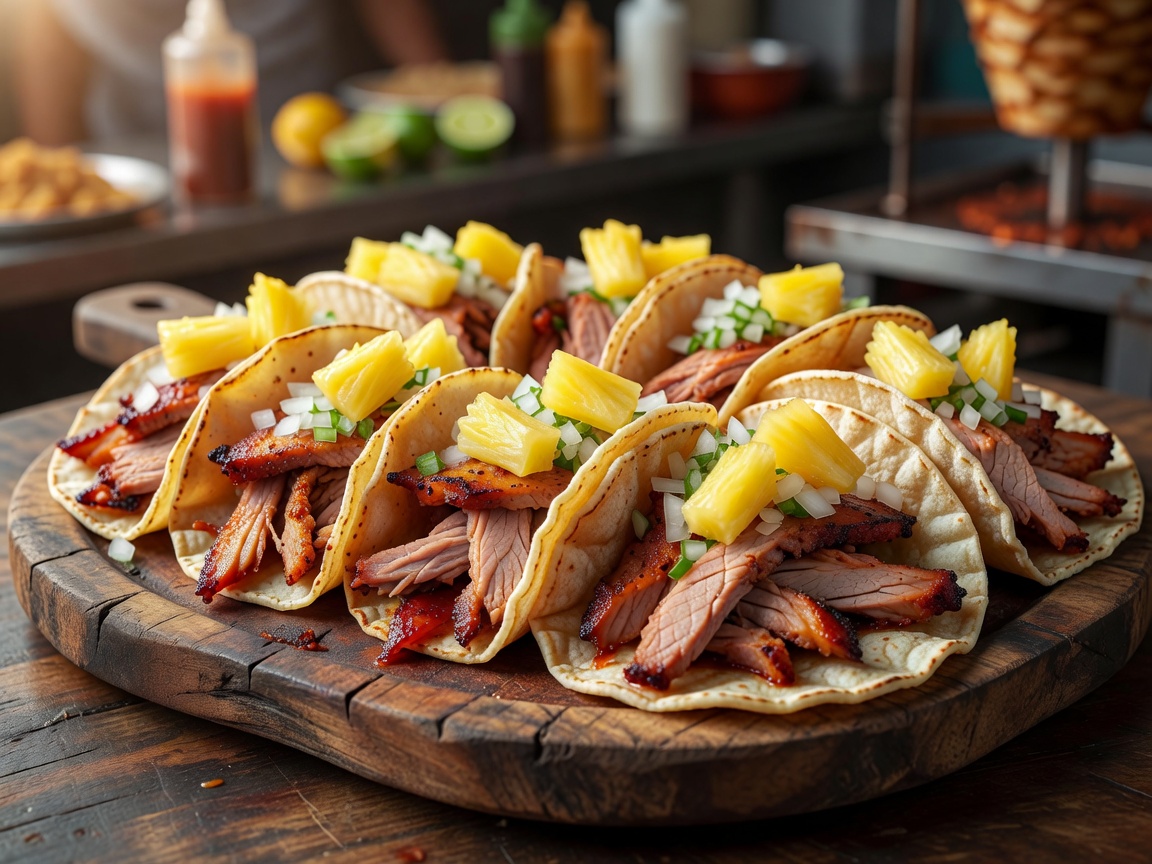
In the vibrant, late-night streets of Mexico City, the neon lights of taquerías reflect off spinning vertical spits of deep-red pork topped with a whole peeled pineapple. This is the trompo—the heart and soul of Tacos al Pastor.
The Lebanese Migration & Origins
Despite being synonymous with Mexican identity today, the roots of Tacos al Pastor trace back to the 1920s with the arrival of Lebanese immigrants to the state of Puebla. Bringing their traditional cooking method of vertical spit-roasted lamb (shawarma), local Mexican street vendors adapted the recipe over decades.
They substituted lamb with accessible pork shoulder, marinaded the meat in local achiote paste, dried guajillo and ancho chilies, vinegar, and indigenous spices, and served the shaved meat on warm corn tortillas rather than pita bread.
Anatomy of Perfect Tacos al Pastor
A true Taco al Pastor requires precise balance. Here are the core essential components:
- The Marinade (Adobo): A thick blend of achiote paste, guajillo peppers, cumin, garlic, oregano, and vinegar that tenderizes and flavors the pork.
- The Trompo: Thinly sliced pork shoulder stacked tightly on a vertical skewer, roasted slowly beside an open radiant flame.
- The Pineapple Crown: A peeled pineapple sits at the top of the spit; as it heats, juices drip down the stack, tenderizing the outer crust with natural bromelain enzymes.
- Garnishes: Finely chopped white onion, fresh coriander leaves, lime juice, and a fiery salsa verde or habanero salsa.
Where to Experience Authentic Al Pastor in Mexico City
For purists seeking the gold standard of al pastor street dining, these historic spots in CDMX remain essential stops:
- El Vilsito (Narvarte): An auto-repair shop by day that transforms into one of the city's most revered late-night taquerías by night.
- El Farolito (Condesa): Credited with popularizing the charcoal-fired trompo, yielding a distinct smoky crust.
- Los Cocuyos (Centro Histórico): Operating 24/7, serving rich, slow-cooked street tacos under bubbling pots of meat broth.